GrowthCraft

founder productivity

Early-stage startup founders reviewing priorities and making decisions during a focused team meeting.

The Startup Meeting Guide Nobody Teaches You

Early-stage startup founders reviewing priorities and making decisions during a focused team meeting.
The right startup meetings create clarity, accountability, and forward progress without taking time away from the work that matters most.

The Startup Meeting Guide Nobody Teaches You

How Early-Stage Founders Can Build a Meeting Rhythm That Creates Progress Instead of Wasting Time

Your Startup Does Not Have a Meeting Problem. It Has a Meeting Design Problem.

As a startup grows, meetings tend to multiply.

It usually happens without anyone making a deliberate decision. A founder starts scheduling weekly check-ins. A team member asks for a regular status meeting. Leadership conversations become calendar events. Customer issues require discussions. Product questions need alignment.

Before long, a company with five or six people can have a calendar that looks like it belongs to a 500-person organization.

That is a problem.

Early-stage startups have one resource they cannot replace: focused time. Every hour spent in a meeting is an hour that is not spent talking to customers, building the product, selling, solving a problem, or completing meaningful work.

The answer is not to eliminate meetings completely. Startups need communication and alignment. The answer is to become intentional about which meetings exist and what each meeting is supposed to accomplish.

A good startup meeting should have a clear purpose that cannot be accomplished more effectively through an email, shared document, asynchronous update, or quick conversation.

The question founders should ask is simple:

What decision, problem, or relationship will be better because these people spent this time together?**

If there is no clear answer, the meeting probably should not exist.

This matters even more for first-time founders. You are not simply managing your own time. You are teaching your company how to work. The meeting habits you establish when the company has five employees often become the habits that follow you when the company has 25, 50, or 100.

That is why building the right meeting rhythm early is part of building your startup’s operating system.

—

Why Startups Need Fewer Meetings, Not More

There is a common assumption that more communication requires more meetings.

That is not always true.

More meetings can actually create less communication because people begin spending so much time reporting on work that they have less time to do it. Information becomes fragmented across conversations. Decisions get revisited repeatedly because no one is clear about who owns them.

A recent discussion in the [Harvard Business Review] (https://hbr.org/podcast/2026/06/we-all-hate-meetings-heres-how-to-make-them-work?utm_source=chatgpt.com) highlighted a problem that will sound familiar to many founders: organizations often need to examine which meetings should happen less frequently, involve fewer people, or disappear entirely. The underlying point is important for startups. Meeting discipline requires process discipline.

Early-stage companies should resist the temptation to copy the meeting structures of large companies.

You probably do not need a Monday morning leadership meeting, a Tuesday product meeting, a Wednesday sales meeting, a Thursday operations meeting, and a Friday company-wide status meeting.

You need a small number of meetings that accomplish specific jobs.

A useful startup meeting system should do four things:

1. Create alignment around priorities. People should understand what matters most right now and why.

2. Surface problems quickly. Meetings should identify obstacles that require discussion or decisions before they become larger problems.

3. Create accountability. Important commitments should have an owner and a clear follow-up point.

4. Strengthen the working relationships that are necessary to build the company. Some conversations, especially between founders and team members, cannot be replaced by project management software.

Everything else should be questioned.

—

The Meetings Every Startup Actually Needs

There is no universal meeting calendar that works for every startup. A two-person company should not operate like a 20-person company.

However, most early-stage startups eventually benefit from a basic rhythm built around five types of conversations:

  • Weekly founder meetings
  • Team one-on-ones
  • Leadership meetings
  • Monthly reviews
  • Quarterly planning sessions

The important distinction is that each meeting has a different purpose.

The biggest mistake founders make is trying to discuss everything in every meeting.

Your weekly founder meeting should not become a detailed monthly financial review. Your one-on-one should not become a project status meeting. Your quarterly planning session should not become a three-hour argument about something that happened yesterday.

Each meeting should have a job.

—

1. Weekly Founder Meetings: The Meeting That Keeps the Company Aligned

If your startup has more than one founder, the weekly founder meeting may be one of the most important meetings in the company.

Do not assume that because you talk throughout the week, you are aligned.

Casual conversations often create the illusion of alignment while important assumptions remain unspoken.

A structured weekly founder meeting creates time to step back from daily activity and ask:

  • What changed this week?
  • What are we learning from customers?
  • What is working?
  • What is not working?
  • What decisions need to be made?
  • Where are we losing focus?
  • What are the three most important priorities for next week?

This meeting should usually be between 45 and 60 minutes.

The goal is not to review every task. The goal is to discuss the issues that require founder-level attention.

A simple agenda might begin with a quick review of commitments from the previous week. Follow that with the most important numbers or signals from customers and the business. Then spend the majority of the meeting discussing decisions, problems, and priorities.

End with clear commitments.

Every founder should leave knowing what they own before the next meeting.

This is particularly important when founders have different functional responsibilities. The CEO may be focused on customers and fundraising while another founder is focused on product or technology. Without a regular forum, those separate priorities can slowly become separate companies operating under the same name.

—

2. Team One-on-Ones: Use Them to Understand People, Not Just Projects

One-on-one meetings are often misunderstood.

Many managers use them as project status meetings. The employee explains what they did last week. The manager asks what they are doing next week. Then both people return to work.

That is not the best use of the time.

One-on-ones should focus on the person, their challenges, their development, and the obstacles that may not surface in a group meeting.

Research and management discussions summarized by the [Harvard Business Review’s guide to one-on-one meetings](https://hbr.org/podcast/2024/01/supercharge-your-one-on-one-meetings?utm_source=chatgpt.com) emphasize the importance of being deliberate about these conversations rather than treating them as informal calendar placeholders.

For an early-stage startup, a one-on-one might include questions such as:

What is going well right now? What is frustrating you? What is blocking your progress? What do you need from me? What are you seeing that I may not be seeing?

Those questions are especially valuable because startup employees often see problems before founders do.

The frequency depends on the size and stage of your company. Early employees may benefit from weekly or biweekly one-on-ones. As teams become more experienced and independent, the rhythm may change.

The key principle is this: use one-on-ones to build trust and surface information that would otherwise remain hidden.

Do not waste them reading project management updates to each other.

—

3. Leadership Meetings: Only When You Actually Have a Leadership Team

One of the easiest mistakes for a growing startup is creating a leadership meeting before there is actually a leadership team.

A three-person startup does not need to call every weekly conversation a leadership meeting.

Once you have people responsible for major areas of the business, however, a regular leadership meeting can become useful.

This meeting should focus on cross-functional issues.

For example, sales may be hearing objections from customers that product needs to understand. Product may be changing priorities that affect marketing. Finance may identify a cash issue that changes hiring decisions.

Those are leadership meeting conversations because they require multiple areas of the company to understand the same issue.

A good leadership meeting should answer three questions:

Are we on track? What is off track? What needs a decision?

The meeting should not become a series of department presentations.

If everyone spends ten minutes explaining what their department did last week, you have created a status meeting, not a leadership meeting.

Ask people to provide routine information before the meeting whenever possible. Use the actual meeting for discussion, problem-solving, and decisions.

—

4. Monthly Reviews: Step Back and Look at the Business

Weekly meetings are useful for managing momentum. Monthly reviews are useful for seeing patterns.

A founder can become so focused on this week’s customer call, product issue, or sales opportunity that they miss what the business is telling them over time.

Once each month, take a longer view.

Review the metrics that actually matter at your stage. Depending on your startup, those might include revenue, pipeline, customer acquisition, retention, product usage, cash position, burn rate, or other indicators connected to your current goals.

The point is not to create a complicated dashboard filled with numbers.

The point is to ask:

What changed? Why did it change? What should we do differently?

A monthly review should also look at priorities. Are you still working on the things you said were important 30 days ago? If not, what changed?

This is where the meeting guide connects directly to a startup CEO scorecard.

Your company needs a rhythm for reviewing reality. Without it, founders often manage based on whichever problem feels most urgent that day.

A monthly review creates a pause between activity and reaction.

—

5. Quarterly Planning Sessions: Decide What Matters Before the Quarter Decides for You

Quarterly planning is one of the few meetings that deserves more time.

Startups change quickly, but that does not mean priorities should change every week.

A quarterly planning session gives the team an opportunity to review what happened, identify what was learned, and decide what matters most next.

Guidance from [Atlassian’s quarterly planning framework](https://www.atlassian.com/work-management/strategic-planning/quarterly-planning?utm_source=chatgpt.com) recommends beginning by reviewing the previous period before moving into future plans. That is particularly important for startups because assumptions can change quickly.

Start by reviewing the previous quarter.

What did you accomplish? What did you fail to accomplish? What surprised you? What did customers teach you? What should you stop doing?

Then reconnect the next quarter to the larger company direction.

Your quarterly priorities should not simply be a long list of projects. A small startup has limited capacity. Choosing what not to do is often as important as choosing what to do.

At the end of the session, everyone should understand:

  • The most important company objectives for the quarter
  • The few priorities that support those objectives
  • Who owns each priority
  • How progress will be measured
  • What work is intentionally being deprioritized

That last point matters.

A plan that does not identify what you are saying no to is usually not focused enough.

—

When to Cancel a Meeting

Founders should periodically audit recurring meetings.

Do not assume that because a meeting was useful three months ago, it is useful today.

Cancel or redesign a meeting when its original purpose no longer exists.

You should also question a meeting when the same people regularly attend but do not participate, when the conversation repeatedly covers information that could be shared asynchronously, or when no decisions or actions result from the meeting.

A useful test is to ask everyone attending:

If this meeting disappeared tomorrow, what would break?

If the answer is “nothing,” cancel it.

You can also reduce the frequency. A weekly meeting may need to become biweekly. A monthly meeting may only be necessary quarterly.

Another useful approach is to put an expiration date on new recurring meetings.

Instead of saying, “Let’s meet every Tuesday forever,” say, “Let’s meet every Tuesday for the next six weeks and then decide whether this is still useful.”

That small change forces the team to evaluate whether the meeting is earning its place on the calendar.

—

A Simple Startup Meeting Rhythm

For many early-stage startups, a simple structure might look like this:

Weekly: Founder alignment and priority review.

Weekly or biweekly: Individual one-on-ones focused on people, obstacles, and development.

Weekly or biweekly: Leadership discussion focused on cross-functional decisions, once the company has a genuine leadership team.

Monthly: Business and performance review focused on trends, metrics, priorities, and learning.

Quarterly: Strategic review and planning focused on what the company learned and what matters most next.

You may need fewer meetings than this.

The important thing is not copying someone else’s calendar. It is making sure every meeting has a purpose.

—

GrowthCraft’s Perspective: Build Your Startup Operating System Before You Need One

The best startup operating systems are not complicated.

They create clarity around how the company makes decisions, sets priorities, reviews progress, and solves problems.

Your meeting rhythm is part of that system.

At [GrowthCraft](https://growthcraft.org), the focus is on helping first-time and early-stage founders create practical frameworks that support execution. GrowthCraft provides founders with access to expert guidance, peer mastermind groups, office hours, and resources designed to help founders work through real business challenges.

That outside perspective can be particularly valuable when a founder is too close to a problem to see it clearly.

A GrowthCraft mastermind group, for example, is designed around regular conversations where founders can share challenges, gain different perspectives, and remain accountable for progress.

That is an important distinction.

Not every problem requires another internal meeting.

Sometimes the best use of a founder’s time is to bring the problem to people who have no internal agenda and can challenge your assumptions.

As your company grows, your meeting system will change. That is normal.

But the discipline should remain the same:

Meet for a reason. Make decisions. Assign ownership. Follow through. Cancel what no longer helps.

The goal is not to build a company that is excellent at meetings.

The goal is to build a company that makes progress.

—

Frequently Asked Questions About Startup Meetings

How many meetings should an early-stage startup have?

There is no perfect number, but early-stage startups generally need fewer recurring meetings than larger organizations. Start with the minimum structure necessary for alignment, decision-making, accountability, and communication. Add meetings only when there is a clear problem they solve.

How long should a startup weekly meeting be?

Most weekly founder or leadership meetings can be effective in 45 to 60 minutes when participants come prepared and the agenda focuses on decisions and problems rather than detailed status reporting.

What should not be discussed in a meeting?

Routine updates that can be communicated through a shared document, project management system, or short message usually do not require meeting time. Meetings are most valuable when people need to make decisions, solve complex problems, discuss sensitive issues, or build relationships.

Should startup founders meet every week?

In most multi-founder startups, a dedicated weekly founder meeting is valuable. Even founders who communicate frequently can develop different assumptions about priorities, customers, and company decisions. A structured weekly conversation creates space to address those issues before they become larger problems.

When should you cancel a recurring meeting?

Cancel or redesign a recurring meeting when it no longer has a clear purpose, produces no decisions or actions, duplicates information available elsewhere, or continues simply because it has always existed. Review recurring meetings regularly as the startup changes.

—

Sources and Further Reading

Atlassian: A Guide to Quarterly Planning

https://www.atlassian.com/work-management/strategic-planning/quarterly-planning

Harvard Business Review: Supercharge Your One-on-One Meetings

https://hbr.org/podcast/2024/01/supercharge-your-one-on-one-meetings

Harvard Business Review: We All Hate Meetings, Here’s How to Make Them Work

https://hbr.org/podcast/2026/06/we-all-hate-meetings-heres-how-to-make-them-work

GrowthCraft Resources and support for early-stage founders

GrowthCraft Mastermind Groups

GrowthCraft Office Hours

The Startup Meeting Guide Nobody Teaches You Read More »

Startup founder reviewing business systems and planning priorities to prevent burnout while building a sustainable company.

Founder Burnout Is a Business Problem, Not a Personal Problem

Startup founder reviewing business systems and planning priorities to prevent burnout while building a sustainable company.
Founder burnout is often caused by business systems that rely too heavily on one person. Building repeatable processes creates healthier companies.

Founder Burnout Is a Business Problem, Not a Personal Problem

When most people picture a startup founder, they imagine someone working late nights, answering emails at midnight, skipping vacations, and sacrificing nearly everything to build a company. Society often celebrates this image as proof of commitment and determination.

Unfortunately, this mindset has also contributed to one of the most common reasons startups fail.

Founder burnout.

Burnout is often treated as a personal issue. Founders are told they need better work-life balance, more sleep, better exercise habits, or improved stress management. While those things certainly matter, they miss the bigger picture.

Burnout is usually the result of how a business is designed and operated.

If every decision depends on one person, if every customer problem lands on the founder’s desk, and if every process exists only inside the founder’s head, the company itself creates burnout.

That makes burnout a business problem.

For first-time founders, recognizing this distinction is incredibly important. The goal is not simply to survive another week. The goal is to build a company that can continue growing without requiring the founder to carry every responsibility forever.

This article explores why founder burnout happens, how to recognize it early, and the practical systems every startup should build to avoid becoming another burnout statistic.

Why Founder Burnout Kills Startups

Most startups begin with one person doing nearly everything.

Sales.
Marketing.
Product development.
Customer support.
Finance.
Operations.
Fundraising.

At first, this makes sense. Resources are limited, budgets are small, and hiring is often impossible.

The problem begins when the company starts growing but the founder never changes how work gets done.

Instead of building systems, founders simply work harder.

Instead of documenting processes, they memorize everything.

Instead of delegating decisions, they become the bottleneck.

Eventually, every important activity depends on one exhausted individual.

Research continues to show that founder mental health challenges are widespread. A study by the National Institute of Mental Health highlights the relationship between chronic stress and impaired decision making. Similarly, the Harvard Business Review has published multiple studies showing that sustained overload significantly reduces strategic thinking, creativity, and leadership effectiveness.

For startups, these consequences become expensive.

Burned-out founders often experience:

  • Slower decision making because every choice feels overwhelming rather than exciting.
  • Reduced creativity, making it harder to solve customer problems or identify new opportunities.
  • Poor communication with investors, employees, and customers.
  • Delayed product improvements because priorities constantly shift.
  • Lower team morale because stress spreads throughout the organization.

Burnout rarely appears overnight.

It usually builds slowly while the business continues operating.

By the time founders realize something is wrong, many opportunities have already been missed.

Early Warning Signs

Many founders mistake burnout for being “busy.”

Being busy is temporary.

Burnout is different.

Burnout changes how you think, make decisions, and interact with your business.

Some of the earliest warning signs include consistently avoiding important work because everything feels equally urgent. Instead of focusing on strategic priorities, founders spend their days reacting to emails, Slack messages, customer requests, and emergencies.

Another warning sign is decision fatigue.

Simple decisions begin taking much longer than they should.

Choosing between two vendors suddenly feels exhausting.

Responding to customer feedback becomes emotionally draining.

Even scheduling meetings feels like another impossible task.

Burnout also affects relationships.

Founders may become less patient with employees, customers, advisors, or family members. Communication becomes shorter, frustration increases, and collaboration suffers.

Perhaps the biggest warning sign is losing enthusiasm for work that once felt exciting.

Building a startup will always involve difficult days.

But if every day feels heavy for weeks or months, the business itself probably needs attention.

Delegation Versus Doing Everything Yourself

Many founders believe nobody can perform a task as well as they can.

Sometimes that is true.

Most of the time, it is not.

The bigger issue is whether the founder should be performing that task in the first place.

Successful founders gradually shift from doing work to designing work.

That means creating repeatable processes that others can execute consistently.

Delegation is not simply assigning tasks.

Effective delegation requires three things.

First, clearly define the desired outcome. Team members need to understand what success looks like rather than simply receiving instructions.

Second, document the process whenever possible. Even a simple checklist can eliminate confusion and reduce repeated questions.

Third, establish decision boundaries. Employees should know which decisions they can make independently and when they should involve leadership.

Delegation often feels slower initially because teaching someone takes time.

However, every hour invested in training eventually returns many hours of founder capacity.

Think of delegation as building an asset.

Each documented process becomes something the company owns rather than something only the founder knows.

Building Systems Before Hiring

Many founders assume hiring solves burnout.

It often does not.

Hiring without systems simply transfers chaos to more people.

Imagine hiring your first sales representative without documented pricing, qualification criteria, customer messaging, or CRM processes.

Instead of reducing workload, the founder now spends every day answering questions.

The employee becomes dependent rather than productive.

Before hiring, startups should identify recurring activities that happen every week.

These might include:

Every customer onboarding meeting should follow the same sequence.

Marketing content should follow a documented approval process.

Customer support requests should include standard response procedures.

Sales follow-up should have defined timelines and templates.

Financial reporting should occur on the same schedule each month.

None of these systems need to be complicated.

Simple documents stored in shared folders often provide enough structure for early-stage companies.

The objective is consistency.

When work becomes predictable, scaling becomes easier.

Creating Founder Operating Rhythms

One overlooked cause of burnout is constantly changing priorities.

Without structure, founders spend every day reacting.

Successful CEOs create operating rhythms that reduce unnecessary decision making.

An operating rhythm is simply a consistent schedule for recurring leadership activities.

For example:

Monday might focus on company planning and reviewing key metrics.

Tuesday could be dedicated to customer meetings.

Wednesday might become product development time.

Thursday could focus on partnerships or fundraising.

Friday becomes review, documentation, and preparation for the following week.

This structure creates mental clarity.

Instead of asking, “What should I work on today?” founders already know.

Operating rhythms also improve communication.

Employees understand when decisions are made, meetings occur, and priorities are reviewed.

Consistency reduces uncertainty across the entire company.

The Society for Human Resource Management (SHRM) has also noted that predictable work structures reduce workplace stress while improving productivity and engagement.

Weekly CEO Checklist

Every founder should schedule time each week to step away from daily tasks and evaluate the business itself.

A simple weekly CEO checklist might include:

Review Key Metrics

Look beyond revenue. Examine customer acquisition, retention, cash flow, sales pipeline activity, product usage, and customer satisfaction. Trends often matter more than individual numbers.

Evaluate Bottlenecks

Identify which decisions required founder involvement this week. Ask whether any could become documented processes or delegated responsibilities.

Talk to Customers

Spend time understanding customer experiences directly. Founders should remain connected to real problems even as the company grows.

Review Team Priorities

Ensure everyone understands the week’s objectives. Misalignment creates unnecessary work and increases stress throughout the organization.

Protect Strategic Thinking Time

Reserve uninterrupted time each week to think about long-term direction instead of immediate tasks. This often becomes the highest-value activity on the calendar.

Reflect Personally

Ask simple questions.

What gave me energy this week?

What drained my energy?

What should I stop doing?

The answers often reveal where systems need improvement.

How GrowthCraft Helps Founders Avoid Burnout

Many founders believe they need more motivation.

What they actually need is better structure.

This is where GrowthCraft makes a meaningful difference.

GrowthCraft was created specifically to help early-stage founders navigate the challenges of building companies without feeling isolated or overwhelmed.

Rather than simply offering educational content, GrowthCraft provides practical guidance, experienced mentors, collaborative communities, and proven startup frameworks that help founders make better decisions earlier.

Members gain access to resources covering business planning, customer validation, financial readiness, fundraising preparation, operational planning, and leadership development.

More importantly, founders gain access to people who have experienced similar challenges.

Many startup problems feel unique until founders discover others have already solved them.

GrowthCraft helps founders avoid common mistakes before they become expensive setbacks.

By building stronger operating systems early, founders spend less time fighting daily fires and more time creating sustainable businesses.

Burnout prevention is not about working fewer hours.

It is about building companies that no longer require one person to do everything.

That is exactly the type of long-term thinking GrowthCraft encourages.

Final Thoughts

Every startup demands hard work.

There will always be long days, difficult decisions, and periods of uncertainty.

But constant exhaustion should never become the operating model.

If your company only functions because you never stop working, your business has a systems problem, not a motivation problem.

The earlier founders recognize this reality, the easier it becomes to build processes, delegate responsibilities, establish routines, and create sustainable growth.

The strongest startups are not built by founders who can endure the most stress.

They are built by founders who create businesses that can thrive without depending on constant personal sacrifice.

Invest in systems.

Protect your decision-making capacity.

Build operating rhythms.

Ask for help before you need it.

Most importantly, remember that taking care of the business includes taking care of the person leading it.

GrowthCraft exists to help founders do both.


Frequently Asked Questions

1. What causes founder burnout?

Founder burnout usually results from prolonged stress combined with unclear priorities, constant decision making, lack of delegation, and businesses that depend too heavily on one individual. It is often a symptom of operational problems rather than personal weakness.

2. How can founders prevent burnout?

Founders can reduce burnout by documenting processes, delegating responsibilities, creating consistent weekly operating rhythms, tracking meaningful business metrics, and seeking mentorship before problems become overwhelming.

3. Is burnout common among startup founders?

Yes. Multiple studies have shown that entrepreneurs experience significantly higher levels of stress, anxiety, and burnout than many other professions because they often carry responsibility for employees, customers, investors, and financial outcomes simultaneously.

4. Should founders hire more people to reduce burnout?

Not immediately. Hiring without clear systems often creates additional management work. Startups should first document recurring processes so new employees can contribute effectively from the beginning.

5. How does GrowthCraft help prevent founder burnout?

GrowthCraft provides founders with educational resources, experienced mentors, practical startup frameworks, collaborative communities, and strategic guidance that help founders build sustainable companies with stronger operating systems and healthier leadership practices.


References and Sources

Founder Burnout Is a Business Problem, Not a Personal Problem Read More »

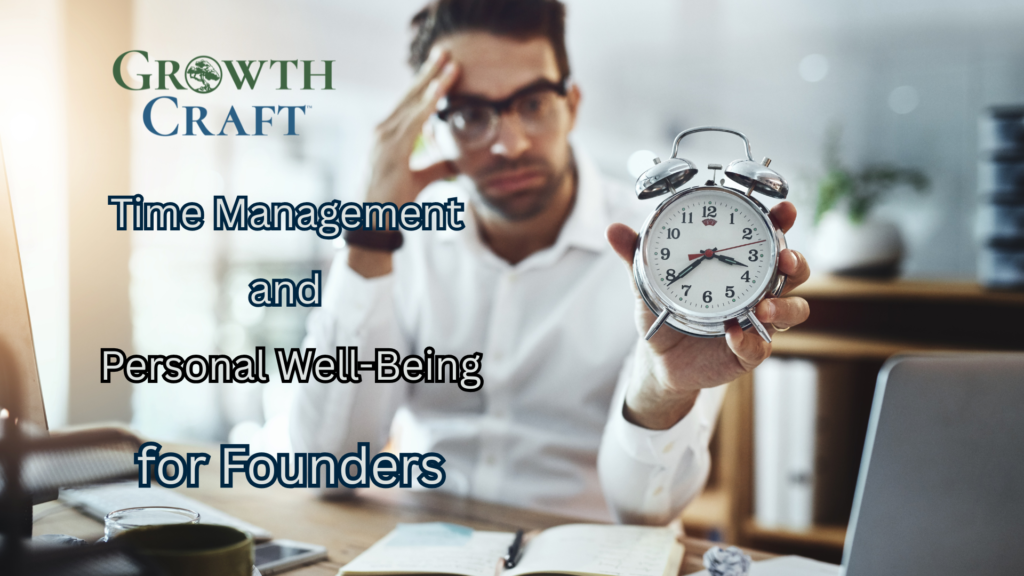
How Startup Founders Can Master Time Management and Personal Well-Being Without Burning Out

How Startup Founders Can Master Time Management and Personal Well-Being Without Burning Out

Introduction: The Founder Paradox – Growth vs. Sustainability

Startup founders are expected to be visionaries, operators, fundraisers, recruiters, marketers, and problem-solvers…all at once. The intensity is exhilarating, but it’s also dangerous. Poor time management and neglected personal well-being are two of the fastest paths to founder burnout, decision fatigue, and ultimately, company failure.

Many founders believe that sacrifice equals success. Long hours, skipped meals, and sleepless nights are often worn as badges of honor. But research, investor insights, and lived experience increasingly show the opposite: founders who manage their time intentionally and prioritize personal well-being make better decisions, lead stronger teams, and build more resilient companies.

This article explores how startup founders can balance the relentless demands of building a company while protecting their most critical asset, themselves!

Why Time Management and Well-Being Are Founder Responsibilities, Not Luxuries

Founders often treat time management as a tactical issue and wellness as a personal one. In reality, both are strategic leadership functions.

When founders are overwhelmed:

  • Everything feels urgent
  • Long-term strategy gets crowded out by “firefighting”
  • Decision quality drops
  • Culture suffers
  • Burnout becomes inevitable

Effective founders recognize that how they manage their time directly impacts how the company grows, and how they manage their health determines how long they can sustain that growth.

The Biggest Time Management Challenges Founders Face

Before jumping into solutions, it’s important to acknowledge the most common obstacles founders encounter:

1. Everything Feels Urgent

Customer issues, investor emails, team questions, product decisions, everything demands attention now.

2. Constant Context Switching

Meetings, Slack messages, emails, and ad hoc requests fragment the day and destroy deep focus.

3. Founder Dependency

Early-stage teams often rely on the founder for decisions that could (and should) be delegated.

4. No Clear Boundaries

Work bleeds into nights, weekends, and personal relationships, creating chronic stress.

Recognizing these patterns is the first step toward changing them.

Proven Time Management Frameworks for Startup Founders

1. The Eisenhower Matrix: Escaping the Urgency Trap

The Eisenhower Matrix helps founders categorize tasks by urgency and importance:

  • Urgent & Important: Crises, deadlines, critical customer issues
  • Important, Not Urgent: Strategy, hiring, product vision, relationships
  • Urgent, Not Important: Interruptions, many emails, unnecessary meetings
  • Neither: Time-wasters

Founders often spend too much time in the Urgent & Important quadrant, constantly reacting. High-performing founders intentionally protect time for Important, Not Urgent work…where real company value is created.

Founder takeaway: If your calendar is full of emergencies, your system, not your effort, is broken.

2. Time Blocking: Designing Your Ideal Founder Week

Time blocking involves scheduling specific blocks of time for specific types of work, deep work, meetings, admin, and recovery.

Some founders, including Elon Musk, reportedly schedule in very small increments (even five-minute blocks). Others prefer larger, theme-based blocks.

Common founder blocks include:

  • Deep work (strategy, product, writing)
  • Meetings
  • Admin and email
  • Learning and reflection
  • Personal health

Why it works: Time blocking reduces context switching, protects focus, and ensures strategic work actually happens.

3. Pomodoro Technique: Focus Without Burnout

The Pomodoro Technique uses 25-minute focused work intervals followed by short breaks.

This approach is especially useful for:

  • Mentally demanding tasks
  • Days filled with complexity
  • Preventing burnout during long work sessions

Founder insight: Short, intense focus periods often outperform marathon workdays.

4. “Eat That Frog”: Winning the Day Early

This technique encourages tackling the most difficult or important task first thing in the morning.

Founders often procrastinate on:

  • Hard conversations
  • Strategic decisions
  • Complex planning work

Completing the hardest task early builds momentum and reduces mental load for the rest of the day.

5. Delegation and Automation: Reclaiming Founder Time

One of the most common founder mistakes is holding onto tasks that don’t require founder-level thinking.

Examples to delegate or automate:

  • Scheduling
  • Reporting
  • Data entry
  • Routine customer support
  • Repetitive internal processes

Automation tools and delegation free founders to focus on vision, strategy, and leadership, the work only they can do.

Recommended Time Management Tools for Founders

Project & Task Management

  • Asana – Structured project tracking for teams
  • Trello – Visual task boards for simplicity
  • Notion – All-in-one workspace for docs, tasks, and planning
  • Todoist – Lightweight personal task management

Calendar & Scheduling

  • Google Calendar – Time blocking and visibility
  • YouCanBookMe – Automated meeting scheduling
  • Calendly – Open your calendar to allow people to book you without the email trails

Time Tracking & Focus

  • Toggl Track – Understand where time actually goes
  • RescueTime – Identify digital distractions
  • Forest – Gamified focus for deep work sessions

Why Founder Well-Being Is a Competitive Advantage

Founders are increasingly recognizing that burnout is not a badge of honor…it’s a business risk.

Neglecting personal well-being leads to:

  • Poor judgment
  • Short-term thinking
  • Emotional reactivity
  • Physical exhaustion
  • Increased founder turnover (or worse)

Well-being isn’t about doing less. It’s about sustaining high performance over the long term.

Core Personal Well-Being Practices for Founders

1. Consistent Routines Reduce Decision Fatigue

Morning and evening routines that include exercise, reflection, or meditation reduce cognitive load and create stability in chaotic environments.

Consistency creates predictability, something startups naturally lack.

2. Regular Breaks and Intentional Disconnecting

Founders often believe stepping away means falling behind. In reality, regular breaks:

  • Improve creativity
  • Reduce errors
  • Restore energy
  • Improve emotional regulation

Scheduling breaks is not indulgent, it’s preventative maintenance.

3. Sleep and Exercise as Business Functions

Sleep and exercise directly affect:

  • Memory
  • Decision-making
  • Emotional control
  • Leadership presence

High-performing founders treat sleep and exercise as non-negotiable inputs to performance, not optional extras.

Recommended Wellness Apps and Books for Founders

Wellness Apps

  • Headspace – Meditation and mindfulness
  • Calm – Sleep, stress reduction, and mental recovery
  • Happify – Science-based emotional well-being activities

Books for Mindset and Habits

  • Atomic Habits by James Clear – Building sustainable systems
  • Deep Work by Cal Newport – Focus in a distracted world
  • Getting Things Done by David Allen – Mental clarity through structure
  • The Hard Thing About Hard Things by Ben Horowitz – Honest realities of the founder journey

The Biggest Mistakes Founders Make (and How to Avoid Them)

Mistake #1: Confusing Busy with Productive

Fix: Measure outcomes, not hours.

Mistake #2: Avoiding Delegation

Fix: If someone else can do it at 70%, delegate it.

Mistake #3: Ignoring Personal Warning Signs

Fix: Burnout doesn’t arrive suddenly—it signals quietly.

Mistake #4: Treating Wellness as “Later”

Fix: Build systems now, not after things “slow down.”

Final Thoughts: Sustainable Founders Build Sustainable Companies

Time management and personal well-being aren’t separate from startup success…they are foundational to it.

The most effective founders:

  • Design their days intentionally
  • Protect time for deep, strategic work
  • Delegate aggressively
  • Treat health as a leadership responsibility
  • Build systems that support long-term performance

Startups are marathons disguised as sprints. Founders who recognize this early don’t just survive, they lead better, scale smarter, and last longer.

Frequently Asked Questions (FAQs)

1. How many hours should startup founders work?

There’s no magic number. What matters is output, decision quality, and sustainability, not raw hours worked.

2. How do founders avoid burnout without slowing company growth?

By focusing on leverage, delegation, automation, and strategic prioritization founders often grow faster with less burnout.

3. Is work-life balance realistic for startup founders?

Balance may shift over time, but work-life integration with intentional boundaries is both realistic and necessary.

4. What’s the best time management method for founders?

The best method is the one you’ll consistently use. Many founders combine Eisenhower Matrix + time blocking for best results.

5. When should founders start prioritizing wellness?

Immediately. Waiting until burnout appears is already too late.

How Startup Founders Can Master Time Management and Personal Well-Being Without Burning Out Read More »

Scroll to Top