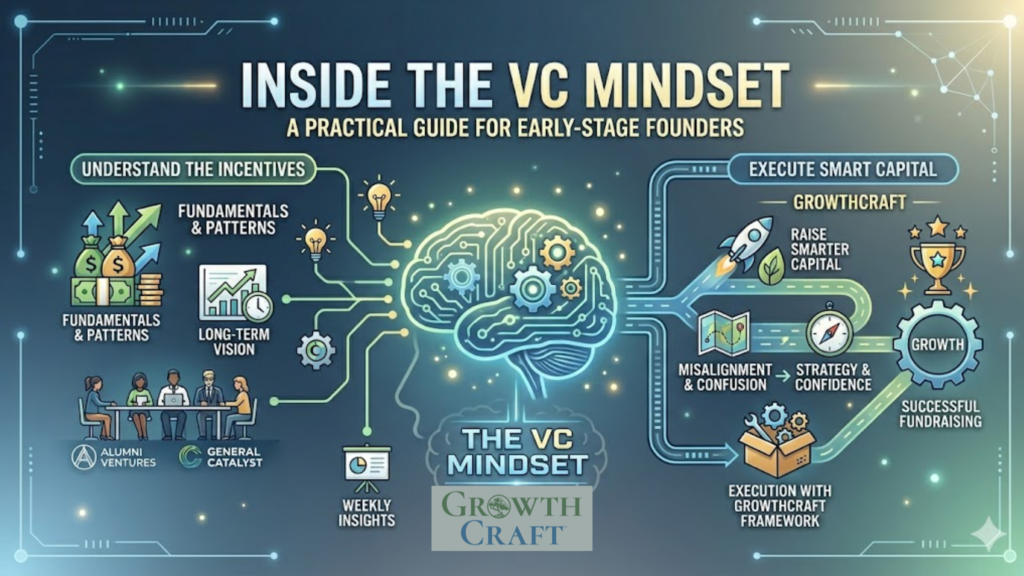
Inside the VC Mindset
A Practical Guide for Early-Stage Founders to Raise Smarter Capital
Early-stage founders often approach venture capital with a mix of urgency, confusion, and unrealistic expectations. The result is usually the same. Misaligned pitches, wasted cycles, and missed opportunities.
The truth is simple. Venture capital is not mysterious. It is structured, patterned, and predictable once you understand the incentives behind it.
This article breaks down how venture capitalists actually think, drawing from industry perspectives like Alumni Ventures and General Catalyst, along with insights from the presentation earlier this week. It also introduces a GrowthCraft framework to help founders translate that understanding into execution.
The Reality Behind Venture Capital
At its core, venture capital is not about ideas. It is about returns.
The structure matters. Investors manage money on behalf of Limited Partners such as pension funds, endowments, and family offices. Their job is to generate outsized returns, often targeting three to five times the total fund size.
This single fact shapes everything.
It explains why:
- Not every “good business” is fundable
- Market size matters more than current revenue
- Speed and scale are prioritized over stability
Firms like General Catalyst consistently emphasize backing companies that can become category leaders, not just profitable businesses. Similarly, Alumni Ventures highlights portfolio diversification and the importance of “power law” outcomes, where a small number of companies drive the majority of returns.
If you are pitching VCs, you are not just selling your company. You are positioning your company as a potential outlier.
Not All Venture Capital is the Same
One of the biggest mistakes founders make is treating all investors the same.
They are not.
Different firms operate at different stages, write different check sizes, and have different expectations.
Early-stage investors are often betting on people and insight. Later-stage investors are betting on metrics and scalability.
Understanding this changes your entire approach. If you pitch a pre-seed idea to a growth-stage fund, it will fail regardless of quality. Not because your company is weak, but because it does not fit their mandate.
This is not personal. It is structural.
What Investors Actually Evaluate
Despite the complexity of venture capital, evaluation tends to center around a consistent set of factors.
The Team
Investors back people before they back products.
They are asking whether you can navigate uncertainty, adapt quickly, and solve problems you have not encountered yet. Execution capability matters more than perfection.
The Market
Market size is not about today. It is about trajectory.
A large but stagnant market is less attractive than a smaller but rapidly expanding one. Investors want to see where the market is going, not where it is.
Traction
Traction is proof of reality.
It can show up as revenue, pilots, user growth, or even strong qualitative signals. What matters is evidence that someone cares about what you are building.
Business Model
How money flows matters early.
Investors are looking for signals of scalability, margin potential, and retention. A business that grows but cannot sustain itself is not investable.
Defensibility
This is about durability.
Network effects, proprietary data, switching costs, or unique positioning all contribute to long-term advantage. Being first is not enough unless it leads to something that compounds.
Thesis Fit
Even if everything above is strong, a deal can still fail.
If your company does not align with the fund’s strategy, it will not move forward.
How Decisions Actually Get Made
The process is more human than most founders expect.
It typically follows a pattern:
- Initial screening for fit
- Introductory conversation
- Internal champion emerges
- Diligence begins
- Investment committee decision
But the most important element is this. Someone inside the firm has to believe in you enough to advocate for you internally.
No champion means no deal.
This is why clarity, conviction, and storytelling matter more than overloading your pitch with detail.
The GrowthCraft POV Framework: Investor Alignment System
At GrowthCraft, we simplify venture capital thinking into a framework founders can actually use.
We call it the Investor Alignment System.
Clarity of Problem
Investors are not looking for interesting ideas. They are looking for painful problems.
Your job is to articulate who experiences the problem, how often, and how severe it is. Urgency matters more than novelty.
Insight-Driven Solution
Your solution should reflect an unfair insight.
This is not about features. It is about why your approach works when others have not. Clarity here builds confidence quickly.
Timing Narrative
Every strong company has a “why now” story.
This could be driven by technology shifts, regulatory changes, or behavior evolution. Without this, even strong ideas feel premature.
Proof of Movement
You need to show that something is already happening.
This could be early customers, engagement, or even strong learning cycles. Momentum reduces perceived risk.
Scalable Economics
Investors want to understand how this becomes large.
This means explaining how revenue grows, how costs behave, and how the business improves over time.
Founder-Market Fit
Why you?
This goes beyond passion. It includes experience, access, and perspective that make you uniquely capable of solving this problem.
How to Present Yourself to Investors
This is where most founders struggle. Not because they lack substance, but because they communicate ineffectively.
Be Clear, Not Clever
Investors should be able to explain your business in simple terms after one conversation.
If they cannot, the pitch did not land.
Lead With Use Case
Most investors are not deeply technical.
They care about who uses your product, why they use it, and what changes because of it.
Show, Do Not Inflate
Avoid exaggerated market sizing like “one percent of a trillion-dollar market.”
Instead, build from the ground up. Show how many customers exist and what they pay.
Be Specific About the Ask
Clarity builds trust.
State how much you are raising and what milestones it will achieve. Vagueness creates friction and uncertainty.
Demonstrate Self-Awareness
Investors trust founders who understand what is not working.
Honesty signals adaptability, which is critical at the early stage.
Should You Even Raise Venture Capital
(Also check out: Investor Money vs. Go-To-Market First)
Not every company should.
Venture capital is designed for high-growth, high-risk outcomes. It comes with expectations around scale, speed, and exit.
According to our workshop that was co-hosted by Alumni Ventures, VC is best suited for companies targeting large markets, requiring capital to accelerate growth, and aiming for outcomes like acquisition or IPO.
If your business does not fit that model, alternatives like angel investment, bootstrapping, or revenue-based financing may be more appropriate.
Choosing the wrong capital can create unnecessary pressure and misalignment.
Using AI and LLMs Productively in Fundraising
AI tools can be powerful in preparing for fundraising, but they need to be used carefully.
They are best used for:
- Structuring pitch narratives
- Refining messaging
- Simulating investor questions
- Identifying gaps in logic
They should not replace judgment.
Founders should validate outputs, ensure accuracy, and avoid over-reliance on generic responses. The goal is augmentation, not substitution.
Key Takeaways
Venture capital is not unpredictable. It is constrained by structure, incentives, and pattern recognition.
Founders who understand this can position themselves more effectively, communicate more clearly, and navigate the process with confidence.
The goal is not to impress investors.
The goal is to align with how they already think.
FAQs
What is the most important factor for VCs at the early stage?
The team is often the most critical factor. Investors are betting on your ability to adapt, execute, and solve problems over time.
How much traction do I need before raising?
It depends on the stage, but you need some form of validation. This could be revenue, user engagement, or strong qualitative insights.
How do I know if a VC is the right fit?
Look at their stage focus, check size, and portfolio. If your company does not align with their thesis, it is unlikely to move forward.
Should I pitch multiple investors at once?
Yes. Fundraising is a process, and momentum matters. Engaging multiple investors can create timing advantages.
Can AI replace the need for investor feedback?
No. AI can help you prepare, but real investor conversations provide context, nuance, and market validation that tools cannot replicate.