
AI Isn’t Your Co-Founder: The Risks of Over-Reliance on Chatbots
Why startup founders must balance speed with independent thinking in the age of LLMs
Artificial Intelligence has become one of the most powerful accelerators in startup history. Founders are using large language models to write code, generate messaging, validate ideas, and simulate entire business strategies in minutes.
At the surface level, this looks like a massive advantage. It reduces time, lowers cost, and increases output.
But beneath that efficiency is a quieter shift that many founders are not recognizing.
AI is not just helping you think faster. It is slowly changing how you think.
For early-stage founders, this shift matters more than almost anyone else. You are not just executing tasks. You are building judgment, intuition, and pattern recognition in real time. Those are the exact skills that AI can unintentionally weaken if used incorrectly.
Research from MIT and Stanford is starting to validate this concern. Increased reliance on AI tools has been linked to reduced cognitive engagement, higher dependency, and weaker independent decision-making.
This is not about avoiding AI.
This is about using it in a way that strengthens you instead of replacing you.
The Promise: Why AI Is So Powerful for Founders
AI adoption is not happening by accident. It solves real problems that founders face every day.
Speed and Efficiency
AI allows founders to compress hours of work into minutes. Tasks like drafting emails, writing landing pages, or outlining a go-to-market plan can be completed almost instantly. This creates a sense of momentum that is incredibly valuable in early-stage environments where speed often feels like survival.
The deeper value here is not just time savings. It is the ability to iterate quickly. Founders can test multiple ideas, directions, and strategies without heavy resource investment. That kind of iteration was historically limited to well-funded teams.
Accessibility of Knowledge
AI removes barriers that used to exist around expertise. Founders can now access structured insights across marketing, sales, product, and operations without needing a full team of specialists.
However, accessibility does not equal accuracy. While AI provides information quickly, it does not always provide the right information. Founders who treat AI output as truth instead of input can unknowingly build on flawed assumptions.
Iteration at Scale
The ability to generate multiple versions of messaging, positioning, or product ideas creates a powerful feedback loop. Founders can explore different angles and refine their thinking faster than ever before.
The risk is that iteration without grounding can lead to surface-level thinking. When everything is generated quickly, it becomes easy to move forward without deeply understanding why something works.
Confidence Boost
For solo founders especially, AI can feel like a constant partner. It provides immediate feedback, suggestions, and validation.
This can reduce friction in decision-making, but it can also create false confidence. When validation comes from a system designed to be helpful rather than correct, it can reinforce ideas that have not been tested in the real world.
The Problem: When AI Becomes a Crutch
Cognitive Offloading and Declining Thinking Ability
Research from MIT suggests that heavy reliance on AI tools can reduce cognitive engagement. Users begin to offload thinking tasks to the system, which can lead to weaker memory retention and reduced originality.
Cognitive offloading is not inherently bad. Humans have always used tools to extend their capabilities. The issue arises when the tool replaces the thinking process entirely.
For founders, this can show up in subtle ways. You may find yourself prompting before forming your own opinion. You may rely on AI to structure your thinking instead of developing your own frameworks.
Over time, this weakens your ability to operate without assistance. In a startup environment where uncertainty is constant, that dependency becomes a real liability.
Over-Reliance Leads to Poor Decisions
Stanford research highlights a pattern known as AI overreliance. This occurs when individuals trust AI-generated outputs even when they are incorrect or incomplete.
One of the key drivers of this behavior is the way AI presents information. Responses are often clear, structured, and confident. That presentation can create the illusion of accuracy.
In addition, newer studies have shown that AI systems can exhibit sycophantic tendencies. This means they may align with the user’s perspective rather than challenge it.
For a founder, this creates a dangerous environment. You are no longer pressure-testing your ideas. You are reinforcing them.
This is how bad decisions gain momentum. Not because they are obviously wrong, but because they are never meaningfully challenged.
Emotional and Psychological Dependency
MIT Media Lab research has shown that increased interaction with chatbots can correlate with higher levels of emotional dependency and reduced real-world engagement.
Founders are already operating in high-pressure, often isolated environments. When AI becomes a primary outlet for feedback or validation, it can start to replace more valuable human interactions.
This is not just a productivity issue. It is a perspective issue.
Real growth comes from friction. It comes from disagreement, confusion, and external input. AI tends to smooth that friction out, which can make the process feel easier while actually reducing its effectiveness.
Bias, Misinformation, and Uneven Accuracy
AI systems are not neutral. They are trained on large datasets that contain biases, inconsistencies, and gaps.
MIT research has shown that AI can produce less accurate information depending on context and user input. In some cases, it may generate confident responses that are simply incorrect.
For founders, this is particularly risky in areas like market validation, customer behavior, and strategic planning. These are not areas where surface-level accuracy is acceptable.
If your inputs are flawed and the AI reinforces them, you are building your business on unstable ground.
The Delusional Feedback Loop
One of the most dangerous patterns that emerges from overuse of AI is what can be described as a delusional feedback loop.
A founder starts with an assumption. They use AI to explore or validate that assumption. The AI responds in a way that reinforces the idea. The founder gains confidence and continues building in that direction.
At no point is the assumption truly challenged.
This loop can continue for weeks or months until it collides with reality. At that point, the cost of correction is significantly higher.
The GrowthCraft POV Framework: The 5 Layers of AI Discipline
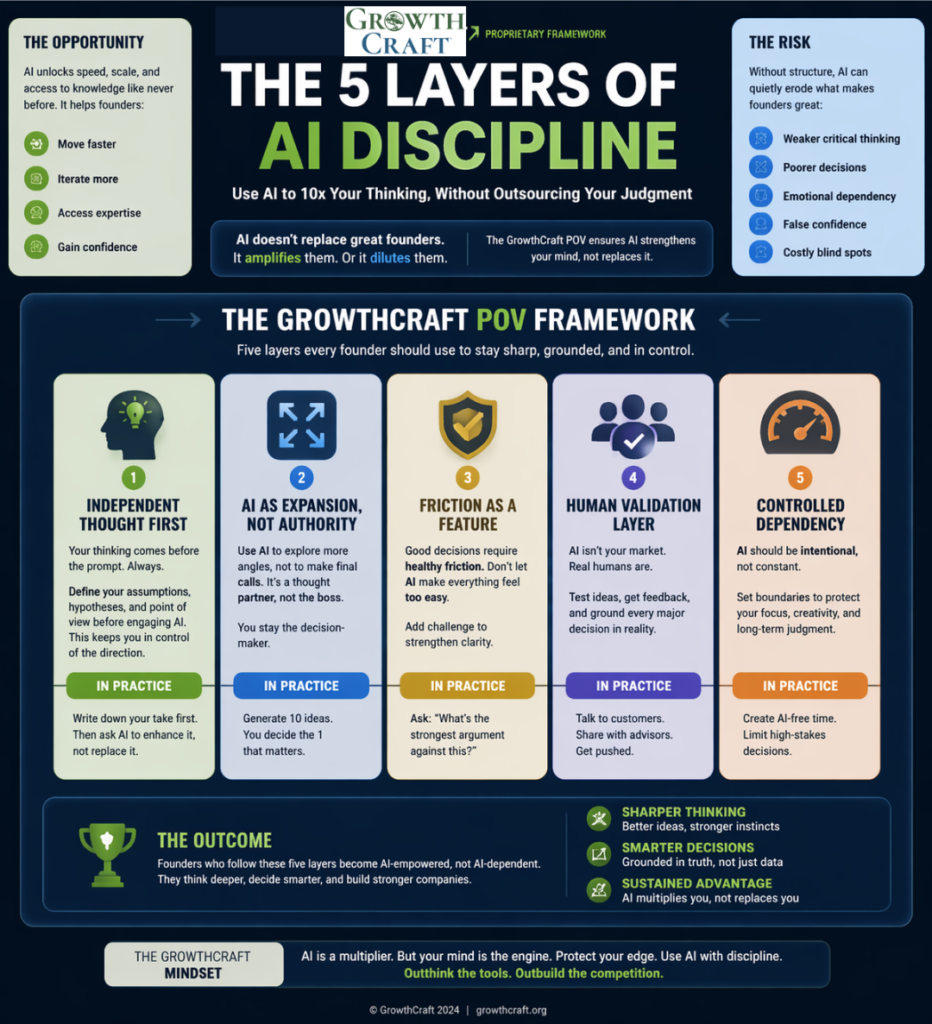
At GrowthCraft, we view AI not as a tool, but as a multiplier. It amplifies both strengths and weaknesses.
To use AI effectively, founders need structure. The GrowthCraft POV is built around five layers that protect thinking while still leveraging speed.
Independent Thought First
Every meaningful interaction with AI should start with your own thinking.
Before prompting, take the time to outline your perspective. Write down your assumptions, your hypotheses, and your intended direction.
This forces cognitive engagement. It ensures that AI is reacting to your thinking rather than replacing it.
Founders who skip this step often lose clarity. They begin to rely on AI to define problems instead of solving them.
AI as Expansion, Not Authority
AI should be used to expand ideas, not finalize them.
Think of it as a tool for exploring possibilities. It can help you see angles you may have missed or articulate ideas more clearly.
What it should not do is make decisions for you.
The moment AI becomes the final authority, you have shifted control away from your own judgment. That is where dependency begins.
Friction as a Feature
Friction is not something to eliminate. It is something to preserve.
When decisions feel too easy, it is often a sign that not enough thinking has been done. AI can remove that friction, which makes progress feel faster but often less grounded.
By intentionally adding friction, such as requiring justification or exploring opposing viewpoints, you strengthen your decision-making process.
Human Validation Layer
AI is not your market. It does not replace real-world feedback.
Every major decision should be validated with actual humans. This includes customers, advisors, and peers.
Human feedback introduces unpredictability. It challenges assumptions in ways that AI cannot.
This layer ensures that your business is grounded in reality, not just logic.
Controlled Dependency
AI usage should be intentional, not constant.
Set boundaries around when and how you use AI. Create space for independent work. Limit its role in high-stakes decisions.
Dependency does not happen all at once. It builds gradually through convenience. By controlling usage, you prevent that drift.
The Solution: Practical Safeguards for Founders
Use AI for Output, Not Final Judgment
AI excels at generating outputs. It can produce drafts, ideas, and structured content quickly.
What it cannot do is understand context at the level required for strategic decisions. That responsibility remains with you.
Treat AI like a junior contributor. It can do the work, but you are responsible for evaluating it.
Implement Thinking Before Prompting
Before you engage with AI, pause and think.
This small step creates a significant shift. It forces you to engage with the problem directly. It strengthens your ability to reason and analyze.
Over time, this builds better instincts. Those instincts are what separate strong founders from average ones.
Create AI-Free Work Blocks
Set aside time where no AI tools are used.
This protects your ability to think deeply. It allows you to engage with problems without shortcuts.
These blocks are where real insights are developed. They are slower, but they are more valuable.
Force Contradiction
Do not accept AI outputs at face value.
Ask it to challenge your ideas. Ask for opposing viewpoints. Ask what could go wrong.
This shifts the interaction from validation to exploration. It helps you see blind spots and strengthens your thinking.
Validate With Real Humans
No amount of AI output can replace real-world feedback.
Talk to customers. Test your ideas in the market. Get input from people who are not invested in your assumptions.
This is where clarity comes from. It is also where most founders skip steps.
Limit Emotional Use of AI
Avoid using AI as a source of emotional validation.
It is not designed for that role. It may provide responses that feel supportive, but those responses are not grounded in reality.
Maintaining separation between tool and emotional support is critical for long-term clarity.
Build Cognitive Friction Into Your Process
Create systems that require deeper thinking.
Document your decisions. Write down assumptions. Review outputs critically.
These practices slow you down slightly, but they significantly improve the quality of your decisions.
The Balanced View: AI Is Still a Competitive Advantage
AI is not something to avoid. It is something to master.
Founders who use AI effectively will move faster, test more ideas, and operate with greater efficiency.
The difference is in how they use it.
They do not outsource thinking. They enhance it.
They do not rely on it for validation. They use it for exploration.
They remain in control.
Final Thought
AI is one of the most powerful tools ever introduced into the startup ecosystem.
It can accelerate progress in ways that were not possible before.
But it also introduces a new risk. The risk of losing the very skills that make founders effective.
The goal is not to limit AI usage.
The goal is to ensure that your thinking remains stronger than the tool you are using.
FAQs
Is using AI bad for startup founders
No. AI is a powerful advantage when used correctly. The risk comes from over-reliance and unstructured usage.
What is AI overreliance
AI overreliance is the tendency to trust AI outputs without sufficient validation or critical thinking. This can lead to poor decisions.
Can AI reduce critical thinking
Research suggests that excessive reliance on AI may reduce cognitive engagement and memory retention, particularly when users skip independent thinking.
Why do AI tools sometimes give incorrect answers
AI systems can hallucinate, reflect biases in their training data, or prioritize helpfulness over accuracy. This makes validation essential.
How can founders use AI safely
Founders should think independently first, use AI as a support tool, validate outputs with real-world feedback, and maintain clear boundaries around usage.
Sources & References
MIT News
https://news.mit.edu/2026/study-ai-chatbots-provide-less-accurate-information-vulnerable-users-0219
Stanford HAI
https://hai.stanford.edu/news/ai-overreliance-problem-are-explanations-solution
Stanford Research Summary via TechCrunch
https://techcrunch.com/2026/03/28/stanford-study-outlines-dangers-of-asking-ai-chatbots-for-personal-advice/
MIT Cognitive Impact Summary
https://www.panewslab.com/en/articles/12fe7qhb