
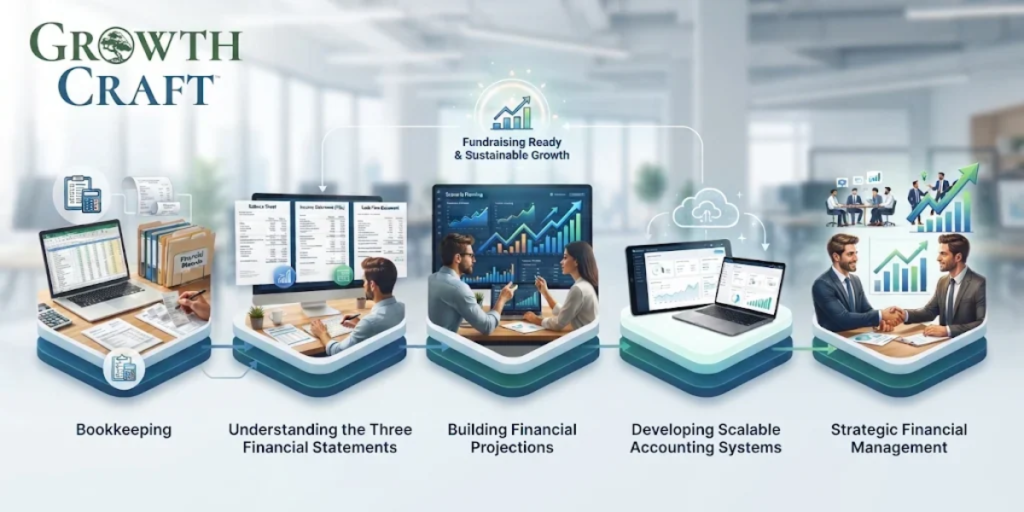
Your Startup’s Financial Foundation: 5 Things Every Founder Needs to Get Right Before Raising Money
Starting a company requires making decisions with incomplete information. You’re developing a product, finding customers, building relationships, and trying to turn an idea into a business. Financial management might not seem like the most exciting part of that process, but it is one of the most important.
Many first-time founders put accounting and finance on the back burner. They keep track of expenses, monitor their bank balance, and assume they’ll get more organized when the company starts generating revenue or preparing to raise money.
Unfortunately, waiting until then can create problems.
Poor financial records make it difficult to understand whether your business is actually healthy. You might be generating revenue but running short on cash. You might believe your company is profitable without accounting for all its expenses. Or you might approach an investor without being able to explain how much money you need, where it will go, and what results it should produce.
Investors want financial information they can trust. More importantly, you need reliable financial information to make good decisions about your own business.
The good news is that you don’t need a full accounting department or an experienced CFO on your first day. You do, however, need to understand the financial basics and establish good habits early.
During a GrowthCraft workshop, JP Puchulu and Joe Wayne of Escaleros discussed five important areas of startup accounting and financial management. Their message is particularly relevant to first-time founders: start simple, establish sound financial practices, and build the infrastructure your company needs as it grows.
Here are five things every founder should understand before raising money.
1. Get Your Bookkeeping Right From Day One
Your financial decisions are only as good as the information behind them. If your bookkeeping is inaccurate, incomplete, or several months behind, every financial report you create is questionable.
Bookkeeping is the process of recording the financial activity of your business. It includes tracking revenue, expenses, bank transactions, credit card purchases, loans, outstanding obligations, invoices, receipts, and other financial records. These transactions eventually become the information used to prepare financial statements, tax returns, and financial projections.
For a very early-stage startup, founders may be able to handle basic bookkeeping themselves. Accounting software makes it easier to categorize transactions, generate reports, and maintain records. However, doing your own bookkeeping doesn’t mean you should ignore the details. You need to understand what is being recorded and why.
One of the first things to do is separate your personal and business finances. Open a dedicated business checking account and obtain a business credit card. Pay business expenses from business accounts and keep personal purchases separate. Mixing the two creates unnecessary confusion, makes tax preparation more difficult, and can complicate the financial review investors conduct before investing.
You should also establish a chart of accounts. This is simply a system for organizing your financial transactions into categories such as revenue, payroll, marketing, software, professional services, equipment, and operating expenses. A properly structured chart of accounts makes it easier to understand where money comes from and where it goes. It should be simple enough for your current needs but flexible enough to accommodate future growth.
Another important decision is whether to use cash-basis or accrual-basis accounting. Under cash-basis accounting, revenue and expenses are generally recorded when money changes hands. Under accrual accounting, revenue is recorded when earned and expenses when incurred, regardless of when payment occurs.
For example, if you invoice a customer in March but don’t receive payment until May, accrual accounting generally records the revenue in March. Cash-basis accounting records it when the payment arrives. Each method provides a different view of the business, and the appropriate method depends on your circumstances, tax requirements, and reporting needs. Discuss the choice with your accountant.
You should also understand GAAP, or Generally Accepted Accounting Principles. These are the standards used to create consistent financial reporting in the United States. Not every private startup is required to prepare GAAP-compliant financial statements, but understanding these standards becomes increasingly important when dealing with sophisticated investors, lenders, and other stakeholders.
Establish a monthly bookkeeping routine:
– Categorize all income and expenses.
– Reconcile bank and credit card accounts against your accounting records.
– Review unpaid customer invoices and outstanding vendor bills.
– Check loan balances and other financial obligations.
– Review your financial reports and investigate unusual transactions.
– Close the month so your records are current and reliable.
The IRS provides useful guidance in its Starting a Business and Keeping Records publication.
Practical takeaway: Start with separate business accounts, accounting software, and a monthly bookkeeping routine. You don’t need to become an accountant, but you do need to understand where your money is going.
2. Understand the Three Financial Statements Every Founder Needs
Making money, owning money, and having money are three different things.
This is one of the most important financial lessons for a startup founder. Your company can generate revenue, appear profitable, and still run out of cash. To understand what’s really happening, you need to know how to read three basic financial statements: the income statement, balance sheet, and cash flow statement.
The Income Statement: Are We Making Money?
Also called a Profit and Loss Statement (P&L), the income statement shows your company’s financial performance over a specific period.
It starts with revenue and subtracts the costs and expenses associated with generating that revenue. These include direct costs, payroll, marketing, rent, software, professional services, and other operating expenses. The result is your net income or loss.
For a startup, the income statement helps answer questions such as: Are sales increasing? Are expenses growing faster than revenue? Which areas of the business are consuming the most money? Are we moving toward profitability?
However, a profitable income statement doesn’t necessarily mean you have money available in the bank.
The Balance Sheet: What Do We Own and What Do We Owe?
The balance sheet provides a snapshot of your company’s financial position at a specific point in time.
It organizes financial information into three categories:
– Assets: What the company owns, including cash, equipment, inventory, and money customers owe you.
– Liabilities: What the company owes, including loans, unpaid bills, and other financial obligations.
– Equity: The owners’ residual interest in the business after liabilities are subtracted from assets.
The balance sheet follows a basic accounting equation:
Assets = Liabilities + Equity.
It helps founders understand the company’s financial position, including how much cash is available, how much debt exists, and how much money is tied up in unpaid invoices or other assets.
The Cash Flow Statement: Where Is the Actual Cash Going?
The cash flow statement tracks money entering and leaving your business over a specific period.
It helps you understand whether your company has enough cash to pay employees, cover operating expenses, purchase equipment, and meet financial obligations.
Two terms every founder should understand are burn rate and runway.
Burn rate measures how quickly your startup is using cash. Runway estimates how long your available cash will last at the current rate of spending.
For example, if your company has $120,000 in available cash and is spending $20,000 more each month than it receives, you have approximately six months of runway.
Why You Need All Three Statements: The $30,000 Customer Project
Consider a startup that completes a $30,000 customer project in March and invoices the customer with net-60 payment terms.
Under accrual accounting, the income statement records the $30,000 in revenue in March because the work has been completed and the revenue earned.
The balance sheet shows the $30,000 as accounts receivable, meaning the customer owes the company money.
But the cash flow statement tells a different story. The company hasn’t received the money yet. It has no additional cash from that project in March, even though payroll, rent, software subscriptions, and other expenses still need to be paid.
The company has generated revenue, but it doesn’t yet have the cash.
This is why looking at only one financial statement can create a misleading picture of your business. The Small Business Administration’s financial management guidance provides a useful introduction to these concepts.
Practical takeaway: Learn to read all three financial statements together. They tell different parts of the same financial story.
3. Build Financial Projections That Reflect Your Business Goals
Financial projections aren’t just documents you prepare when an investor asks for them. They’re a roadmap for running your company.
A financial statement tells you what has already happened. A financial projection estimates what could happen based on your assumptions about the future.
For an early-stage startup, projections help translate business goals into numbers. If your goal is to acquire 100 customers, what will it cost to find them? How much revenue will they generate? How many employees will you need? How much cash will you need to support that growth?
A useful financial model starts with four categories of assumptions.
Revenue assumptions: Estimate how many customers you expect to acquire, what you will charge, how frequently customers will purchase, and how quickly revenue will grow. Be realistic about your sales cycle and the time required to convert prospects into paying customers.
Cost assumptions: Estimate your operating expenses, including payroll, marketing, software, professional services, equipment, and other costs. Consider when you will need to hire additional employees and how those decisions will affect spending.
Timing assumptions: Account for when revenue will actually arrive. A customer who signs a contract today might not pay for 30, 60, or 90 days. Your model needs to reflect that delay.
Funding assumptions: Estimate how much capital you may need, when you will need it, and how you plan to spend it. Consider what happens if fundraising takes longer than expected or revenue develops more slowly than planned.
Your assumptions should be supported by actual business experience whenever possible. Use customer conversations, market research, industry reports, pricing information, and comparable businesses to test whether your expectations are reasonable.
Artificial intelligence can also help founders get started. AI tools can assist with building spreadsheet formulas, organizing assumptions, explaining financial concepts, and creating an initial financial model. But AI-generated projections should never be accepted without review. Incorrect assumptions or formulas can produce very convincing but completely unreliable financial results.
An experienced financial professional can review your assumptions, verify calculations, and ensure your projected income statement, balance sheet, and cash flow statement work together.
The SBA’s business plan guidance also emphasizes the importance of connecting financial projections to funding requirements and explaining how the requested capital will be used.
Practical takeaway: Build an initial financial model using realistic assumptions. Understand every number, know where it came from, and be prepared to explain and defend it.
4. Know When Your Startup Needs More Than Basic Bookkeeping
As your company grows, your financial responsibilities become more complicated. The bookkeeping system that worked when you had three customers and two founders might not be sufficient when you have employees, recurring revenue, investors, inventory, and multiple funding sources.
The important thing is recognizing when your business has outgrown its original financial processes.
At the beginning, basic bookkeeping may be enough. But as activity increases, you’ll need more sophisticated accounting operations and financial reporting.
For example, you may need to introduce:
– Budget-versus-actual reporting: Compare what you planned to spend with what you actually spent. This helps identify unexpected expenses and determine whether your original assumptions remain realistic.
– Key Performance Indicator (KPI) dashboards: Track important financial and operational measurements such as monthly recurring revenue (MRR), customer acquisition cost (CAC), gross margin, customer churn, and operating expenses.
– Cash flow forecasting: Look beyond your current bank balance. A rolling 13-week cash flow forecast helps you anticipate when money will come in, when bills need to be paid, and whether you could face a cash shortage.
– Revenue recognition: As your business introduces subscriptions, long-term contracts, or milestone-based payments, you’ll need to understand when revenue should be recognized in your financial statements.
– Inventory and cost tracking: If you manufacture or sell physical products, you’ll need systems to track inventory, purchasing, production costs, and cost of goods sold.
– Internal financial controls: Establish procedures for approving expenses, managing payments, handling company funds, and controlling access to financial accounts.
– Tax and compliance management: Coordinate sales tax obligations, payroll taxes, business tax filings, and applicable research and development tax credits.
– Investor and grant reporting: If you receive outside investment, SBIR funding, or other grants, you may have additional documentation, expense tracking, and reporting requirements.
These systems don’t all need to be implemented immediately. A startup developing software with a handful of customers has different accounting requirements from a company manufacturing products or managing government-funded research.
The key is to build financial infrastructure that matches the complexity of your business.
It’s also helpful to understand the difference between four levels of financial support.
Bookkeeping focuses on recording transactions, categorizing expenses, reconciling accounts, and keeping financial records current.
Accounting operations take things further by establishing repeatable processes, preparing financial statements, managing the monthly close, and maintaining consistent reporting.
Controller-level support introduces stronger financial controls, more sophisticated reporting, accounting policies, and oversight of the accounting function.
CFO-level guidance focuses on the bigger financial picture, including forecasting, capital planning, fundraising, financial strategy, and helping leadership make informed decisions.
These responsibilities can be handled by different people or combined in one financial services relationship, depending on the company’s size and needs.
This is an area where Escaleros emphasizes building financial systems that grow with the company. Its startup services include scalable bookkeeping, controller-ready systems, month-end reporting, internal controls, and financial support as companies move toward institutional funding.
You can learn more about its approach at Escaleros.
Practical takeaway: Build your financial infrastructure based on the complexity and needs of your business, not simply because another startup is doing it. Add systems when they solve a real business need.
5. Think Strategically About Finance, Not Just Accounting
Accounting tells you what happened. Strategic financial management helps you decide what to do next.
This distinction becomes increasingly important as your company moves from an idea to a functioning business and eventually begins preparing for outside investment.
A founder needs more than accurate financial records. You need to understand how financial decisions affect your company’s ability to grow, compete, and survive unexpected challenges.
Consider a few important areas.
Fundraising and Capital Planning
How much money should you raise? When should you raise it? How much ownership are you willing to give up in exchange for investment?
These decisions should be based on your company’s financial needs and growth objectives, not simply on how much money investors might be willing to provide.
Develop a clear understanding of how much capital you need to reach your next meaningful milestone. Explain what the money will fund, how long it should last, and what progress you expect to achieve.
Cash Flow, Burn Rate, and Runway
Founders need to know how long their money will last. Just as importantly, they need to understand what could change that calculation.
What happens if a major customer delays payment? What if you need to hire sooner than expected? What if fundraising takes six months longer than planned?
Build different scenarios into your financial model. A base-case projection is useful, but a conservative scenario helps you prepare for problems before they become emergencies.
Financial Modeling and Spending Decisions
Every significant business decision has financial consequences.
Hiring another employee increases payroll obligations. Launching a new marketing campaign requires an investment before the results are known. Changing your pricing could improve margins but affect customer acquisition
Financial modeling helps you evaluate these decisions before committing money. It also helps you determine where spending is producing meaningful results and where adjustments are necessary.
KPIs and Performance Measurement
Not every financial metric is equally important to every startup. Identify the measurements that connect directly to your business model and objectives.
A subscription software company might prioritize MRR, churn, customer acquisition cost, and customer lifetime value. A product company might focus on gross margins, inventory turnover, and unit economics.
The goal is to understand which numbers indicate whether your business is moving in the right direction.
Board and Investor Communication
As you begin working with investors, advisors, or a board of directors, you need to communicate your financial position clearly.
That means presenting consistent financial statements, explaining significant changes, identifying risks, and showing how company performance compares with your projections.
Investors don’t expect every startup to be profitable. They do expect founders to understand their numbers and explain the decisions behind them.
Consider Fractional CFO Support
At some point, your company may need experienced financial leadership without having the resources or need for a full-time CFO.
This is where a fractional CFO can help.
A fractional CFO provides strategic financial guidance on a part-time or project basis. Depending on your needs, that support might include financial modeling, fundraising preparation, cash flow management, budgeting, KPI development, and evaluating major financial decisions.
You get access to experienced financial leadership without taking on the expense of another full-time executive.
JP Puchulu and Joe Wayne of Escaleros are examples of the type of financial expertise founders can access as their companies grow. Escaleros combines bookkeeping, accounting operations, controller services, and CFO guidance to support businesses at different stages.
Learn more about JP Puchulu, Joe Wayne, and the Escaleros financial services team.
Practical takeaway: Don’t wait until your company has a financial problem to start thinking strategically about money. The earlier you understand your financial position, the better prepared you’ll be to make important decisions.
Conclusion: Build for Where You Are. Prepare for Where You’re Going.
You don’t need a complicated finance department to build a financially responsible startup. You do need a solid foundation and a willingness to understand the numbers behind your business.
Start with good bookkeeping. Learn to read your income statement, balance sheet, and cash flow statement. Build financial projections based on realistic assumptions. Recognize when your business needs more sophisticated accounting systems, and seek professional financial guidance when the decisions become more complex.
Most importantly, don’t treat accounting as something you do once a year when taxes are due. Financial management should be part of how you operate your company every month.
When you eventually approach investors, having organized financial records and realistic projections will make those conversations much more productive. You’ll be better prepared to explain your business, defend your assumptions, and demonstrate how additional capital will support growth.
GrowthCraft helps early-stage founders understand the many disciplines involved in building a successful business. Through educational workshops, experienced advisors, founder resources, and peer connections, GrowthCraft helps entrepreneurs develop the knowledge to make better-informed decisions.
Financial management is one of those essential disciplines. You don’t have to know everything on day one, but you do need to know what questions to ask and when to bring in someone with the right experience.
Start simple. Build smart. Scale confidently. Think strategically.
That’s how you create a financial foundation that supports your startup today and prepares it for tomorrow.
Editorial notes:
- The article is educational, not individualized accounting or tax advice. Founders should consult qualified professionals about their particular accounting methods, reporting obligations, and tax treatment.
- The article draws on the workshop outline and Escaleros’ published descriptions of its startup financial services. The SBA and IRS resources provide additional authoritative support for the accounting concepts.
Frequently Asked Questions
1. Does an early-stage startup need an accountant?
Not necessarily a full-time accountant. Many early-stage startups can manage basic bookkeeping with accounting software and periodic professional support. However, having an accountant or qualified financial professional review your records, advise on accounting methods, and help with tax compliance can prevent costly mistakes as your company grows.
2. What financial statements should every startup founder understand?
Every founder should understand three financial statements: the income statement, balance sheet, and cash flow statement. The income statement shows revenue and expenses, the balance sheet shows assets, liabilities, and equity, and the cash flow statement tracks money moving into and out of the business. Together, they provide a more complete picture of financial health.
3. What is the difference between cash-basis and accrual-basis accounting?
Cash-basis accounting generally records revenue and expenses when money is received or paid. Accrual accounting records revenue when earned and expenses when incurred, regardless of when payment occurs. The right method depends on your business, tax requirements, and financial reporting needs. Consult an accounting professional before selecting or changing your method.
4. When should a startup hire a fractional CFO?
A startup should consider fractional CFO support when financial decisions become more complex than basic bookkeeping can address. Common triggers include preparing to raise capital, managing significant cash flow challenges, developing financial projections, expanding operations, or needing more sophisticated financial reporting.
5. How far ahead should a startup create financial projections?
A useful starting point is a rolling 12-month financial projection, updated regularly as actual results and business assumptions change. When preparing a business plan or seeking funding, founders may also need longer-term projections. The SBA recommends including financial projections for the next five years in a funding-oriented business plan, with more detailed monthly or quarterly estimates for the earlier periods.
Recommended reference links
These are useful supporting resources for the published article and its readers:
1. Escaleros – Startup accounting, bookkeeping, controller, and CFO services.
2. JP Puchulu, LinkedIn – Workshop presenter and Escaleros CEO.
3. Joe Wayne, LinkedIn – Workshop presenter and Escaleros Director of Client Experience.
4. Escaleros Startup Financial Services – Financial support for startups at different stages.
5. U.S. Small Business Administration: Manage Your Finances – Bookkeeping, accounting methods, financial statements, and accounting assistance.
6. IRS Publication 583 – Starting a Business and Keeping Records.
7. OpenStax: Developing Startup Financial Statements and Projections – Educational resource covering startup financial statements and projections.