

The Best Pitch Deck Outline: A Step-by-Step Guide for First-Time Startup Founders
A great pitch deck does more than explain what your startup does. It tells a compelling story about a problem worth solving, a business worth building, and a team capable of making it happen.
For early-stage, first-time startup founders, creating that story can feel overwhelming. What should you include? How much financial detail is enough? How do you demonstrate that your idea has potential when you are still developing the product or finding your first customers?
The good news is that you do not need 30 slides filled with complicated charts and financial projections. A focused, well-structured pitch deck can communicate your opportunity in 10 to 12 slides.
Think of your pitch deck like a movie trailer. It should introduce the opportunity, build interest, demonstrate why your solution matters, and leave investors wanting to learn more. It is not meant to tell your entire business story. It is meant to earn the next conversation.
This guide walks you through the best pitch deck outline, explains what belongs on each slide, and provides actionable advice for turning your startup idea into a clear, credible presentation.
What Is a Startup Pitch Deck?
A startup pitch deck is a concise presentation that explains your business opportunity to potential investors, partners, or other stakeholders. It typically covers the problem, solution, product, market, business model, competition, traction, team, and financial needs.
Although pitch decks are often associated with fundraising, the process of creating one is also valuable for founders who are not yet ready to raise money. It forces you to clarify your assumptions, identify what you still need to learn, and explain why your business deserves attention.
Successful startups such as Airbnb and Uber have used investor presentations to communicate their business opportunities. Their original decks are useful examples of how founders can explain a business model, market opportunity, and customer need in a relatively compact format. However, there is no single universally successful deck template. Your presentation should reflect your company’s stage, business model, and fundraising objectives.
For most early-stage startups, a 10-slide core presentation is a practical starting point. You can expand it to 12 slides when your team, product, or financial information deserves additional attention.
The Core 10-Slide Pitch Deck Outline
The following outline combines the familiar 10-slide structure with the practical details founders need to explain their product, demonstrate traction, and make a clear funding request. It follows the broad logic of Sequoia Capital’s business-planning and pitching guidance, with additional slides and detail to suit an early-stage fundraising conversation.
Slide 1 – Introduction / Cover
1. Introduction: What does your company do?
Your opening slide should make it immediately clear who you are and what your company does. Include your company name, logo, and a concise, one-sentence description of the value you provide.
Avoid vague statements such as “Revolutionizing the future of business.” Instead, explain what you do in language a potential customer or investor can understand. For example, a home-sharing startup might say, “We help travelers find places to stay with local hosts.”
Actionable tip: Complete this sentence: “We help \(specific customer\) solve \(specific problem\) by \(your approach\).” Use it as a starting point for your tagline. Your opening should establish context, not require the investor to guess what the business is.
Slide 2 – The Problem

2. The Problem: What needs to change?
Investors need to understand the customer pain your business is addressing. Identify the specific people or organizations experiencing the problem, explain what makes it difficult, and show why existing ways of dealing with it fall short.
Use evidence whenever possible. Customer interviews, survey results, industry research, operational data, or a short customer story can help establish that the problem is real. For a business-to-business startup, you might explain how a manual process creates delays, increases costs, or limits a company’s ability to serve customers.
Do not simply claim that “everyone has this problem.” Define the target customer and explain how frequently the problem occurs, how serious it is, and what it costs in time, money, or missed opportunities.
Actionable tip: Speak with potential customers and document their actual experiences. Separate what they told you from what you believe is happening. A specific, well-supported problem is more useful than a dramatic but unsubstantiated claim.
Slide 3 -The Solution

3. The Solution: How do you solve the problem?
Introduce your product or service as the direct response to the problem on the previous slide. Explain what changes for the customer when they use your solution and why your approach is meaningfully different from the alternatives.
Keep the explanation focused on the primary benefit. A long list of features can make it difficult to understand the central value proposition. Instead, describe the key action your product enables and the outcome it is designed to deliver.
For example, rather than saying, “Our platform includes automation, reporting, and AI-powered analytics,” explain how the platform helps a particular customer complete a time-consuming task with less manual work.
Actionable tip: Write one sentence that connects the problem directly to your solution. If the relationship is not obvious, revisit the problem statement or simplify the solution explanation.
Slide 4 – Product / Demo

4. Product / Demo: What does it look like in action?
Give investors a tangible understanding of what you are building. A clear screenshot, prototype, short demonstration, or simple workflow diagram can help turn an abstract idea into something they can see and understand.
Focus on the primary use case. Show how a customer begins, what they do with your product, and what result they receive. You do not need to demonstrate every feature. Choose the part of the experience that best illustrates your value proposition.
If your product is still being developed, be transparent. Label conceptual screens as mockups and explain what is already built, what is being tested, and what remains to be completed.
Actionable tip: Prepare a short, reliable demonstration that can be understood without a lengthy technical explanation. Keep a backup screenshot or recorded demo available in case your live presentation encounters technical problems.
Slide 5 – Market Size
5. Market Size: How large could this opportunity become?
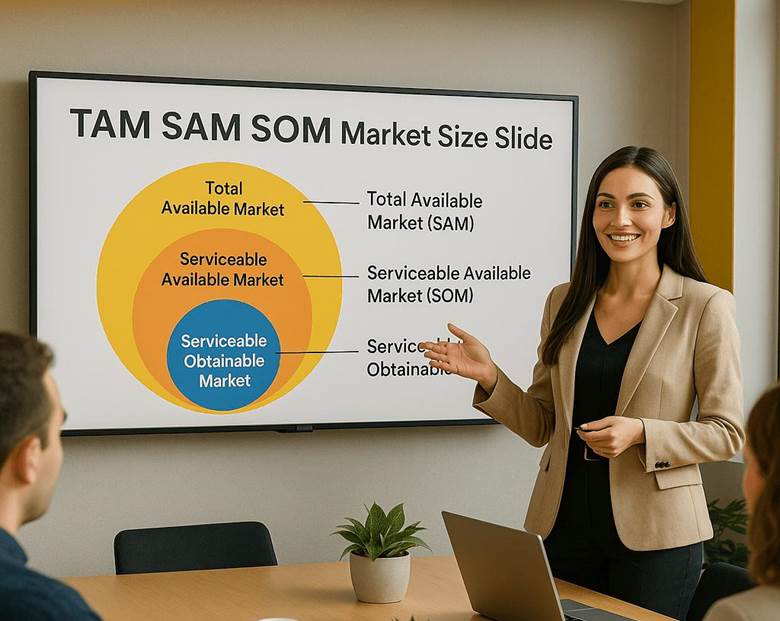
Investors need to understand whether your startup is addressing a sufficiently meaningful market and which portion you can realistically serve. The common framework uses three related measures: TAM, SAM, and SOM.
TAM: Total Addressable Market
The total demand or revenue opportunity if your product or service could serve the entire relevant market.
SAM: Serviceable Available Market
The portion of that market your business model, product, geography, and target customer definition allow you to serve.
SOM: Serviceable Obtainable Market
The portion of the SAM you believe you can realistically capture over a defined period, considering competition, resources, and execution.
A large market number by itself does not establish a viable business. Explain how you calculated your estimates and what assumptions support them. A bottom-up calculation, such as the number of potential customers multiplied by a defensible annual revenue per customer, can make the opportunity easier to evaluate.
Actionable tip: Identify your initial ideal customer profile, estimate how many such customers exist in your reachable market, and explain how you arrived at the numbers. Cite the underlying data and clearly label estimates as estimates.
Slide 6 – Business Model

6. Business Model: How will your startup make money?
Explain who pays you, what they pay for, and how often revenue is generated. Your model might involve monthly subscriptions, annual contracts, transaction fees, licensing, usage-based pricing, or one-time purchases.
Keep the explanation simple enough that someone unfamiliar with your industry can follow it. If you charge a monthly subscription, show the price or pricing range, who buys it, and what the customer receives. If your business depends on transactions, explain how you earn revenue from each transaction.
Where you have reliable information, introduce basic unit economics. These may include customer acquisition cost, average revenue per customer, gross margin, retention, and customer lifetime value. At the earliest stages, these figures may be assumptions rather than established metrics. Label them accordingly.
Actionable tip: Build a simple model showing how one customer generates revenue and what it costs to serve that customer. Explain what you still need to validate before assuming the model can scale.
Slide 7 – Why Now?

7. Why Now? What makes this the right time?
Explain what has changed to make your solution possible, necessary, or commercially relevant now. This could be a new technology, a change in customer behavior, a regulatory development, lower operating costs, or a shift in the way businesses work.
The goal is to connect a real market change to your specific opportunity. For example, if a new technology makes a previously expensive process affordable, explain how that changes the economics for your target customer.
Avoid relying on broad statements such as “AI is growing” or “digital transformation is accelerating.” Those statements do not explain why your particular business has an opportunity today.
Actionable tip: Identify one or two specific changes, provide credible evidence for them, and explain how each affects customer demand, product feasibility, or your ability to compete. If your timing argument is weak, investigate whether the customer problem or business model needs further validation.
Slide 8 – Competition

8. Competition: What alternatives do customers have?
Every startup competes with something, even if no other company offers the exact same product. Customers may use an established competitor, a different type of software, an outside service provider, an internal process, or simply continue doing nothing.
Identify the alternatives your target customers actually consider. Compare the factors that matter to them, such as price, ease of use, implementation time, capabilities, or customer support. Then explain where your approach differs and why that difference matters.
A comparison matrix can make this information easier to digest but avoid giving yourself an automatic checkmark in every category. Unsupported claims of superiority can undermine the credibility of the entire presentation.
Actionable tip: Ask potential customers what they use today and why. Include direct competitors and the status quo. Explain your current advantage and distinguish it from advantages you hope to develop in the future.
Slide 9 – Traction

9. Traction: What evidence shows that your startup is progressing?
Traction is evidence that your startup is making progress toward building a viable business. For a company with paying customers, this might include revenue growth, customer retention, repeat purchases, or expansion within existing accounts.
For an idea-stage or pre-revenue startup, traction can take other forms. You might show completed customer interviews, prototype testing, letters of intent, pilot commitments, waitlist activity, or measurable progress in product development. The important thing is to explain what the evidence actually demonstrates.
Distinguish between interest and commitment. Someone joining a waitlist is not the same as someone paying for a product. A positive interview is not the same as a signed customer agreement. Investors need to understand the difference.
Actionable tip: Select a small number of meaningful metrics, show how they have changed over time, and state the period covered. Include definitions and avoid mixing different types of evidence into a single growth figure.
Slide 10 – The Ask & Financials

10. The Ask & Financials: What do you need, and what will it accomplish?
Finish your core presentation by stating what you are asking investors to provide and what you intend to accomplish with that support. If you are raising capital, specify the amount, the type of financing if known, and the milestones the funding is expected to support.
Explain how much runway the raise is designed to provide, based on your planned spending and assumptions. Then identify the three major milestones you expect to achieve. These might include launching a commercial product, reaching a defined number of paying customers, or completing a technical validation.
Include a simple three-year financial forecast showing expected revenue, major expenses, and cash needs. Your projections should connect to your customer acquisition assumptions, pricing, hiring plans, and other operating drivers. Avoid presenting speculative revenue growth as if it were guaranteed.
Actionable tip: Make sure the numbers agree across your deck. The amount you are raising, expected monthly spending, runway, hiring plan, and milestones should tell one consistent story. Be prepared to explain the assumptions behind your forecast and what you would change if results are slower than expected.
Two Optional Slides Worth Considering
The 10-slide outline is a starting point, not a rule. Depending on your company’s stage and the story you need to tell, two additional slides can make the presentation more complete.
Optional Slide 11: The Team
Investors are evaluating not just the opportunity, but also the people working to make it happen. Introduce the founders and key team members, emphasizing relevant experience, technical knowledge, industry relationships, or previous accomplishments that connect directly to the business.
For a first-time founder, a lack of previous startup experience does not mean you have nothing to show. Relevant customer knowledge, a working prototype, industry expertise, and the ability to learn quickly can all help explain why you are positioned to pursue the opportunity.
If you have advisors, explain their actual contributions. An advisor who has helped validate your market or establish important industry relationships is more meaningful than a list of impressive names without context.
Optional Slide 12: Vision and Milestones
Close with a clear picture of what the company could become if the strategy works. Explain the larger opportunity beyond your initial product or customer segment, while connecting that future to the practical milestones you need to achieve first.
For example, a startup might begin by solving one workflow problem for a specific type of customer, then expand into adjacent workflows or customer segments after validating demand.
Your vision should communicate ambition without replacing the evidence and execution plan presented in the rest of the deck.
How to Make Your Pitch Deck More Effective – A well-structured deck is only the beginning. How you communicate the information can determine whether investors understand your opportunity.
Tell one connected story – Each slide should build on the previous one. The problem establishes why something needs to change. The solution explains what you propose to do. The product demonstrates how it works. The market and business model explain the opportunity, while traction and financials help establish what you have accomplished and what you need next.
If your slides feel like unrelated sections of a business plan, revisit the narrative. Your goal is to make the connection between customer need, business opportunity, and execution clear.
Use evidence instead of unsupported claims – Whenever possible, support important statements with customer feedback, research, product results, financial data, or other credible evidence. Identify the source and time period for key statistics.
Be especially careful with market size, customer demand, competitive advantages, and financial forecasts. Clearly distinguish what you know, what you estimate, and what you still need to validate.
Make every slide easy to understand – Use a clear headline, one primary message, and visuals that support that message. Avoid filling slides with paragraphs of tiny text or complicated charts that require lengthy explanations.
A useful editing exercise is to read only the slide headlines. They should communicate the basic story of your startup from beginning to end.
Adapt the deck to your company’s stage – An idea-stage startup will not have the same evidence as a company with recurring revenue and established customers. That is expected.
An early-stage founder can focus on customer discovery, the problem’s significance, product validation, market assumptions, and the milestones required to move forward. A startup with customers can provide more detail on revenue, retention, acquisition costs, and repeatable growth.
The important thing is to present the evidence you actually have, rather than trying to make your startup look more mature than it is.
How GrowthCraft Can Help You Build a Better Pitch Deck
Creating a pitch deck is not simply a presentation-design exercise. It requires decisions about your customer, market, product, business model, financial assumptions, and growth strategy.
For a first-time founder, those decisions can be difficult to evaluate independently. You may understand your technology extremely well but need help explaining its commercial value. Or you may have a compelling customer problem but still need to validate the market size, pricing, and path to revenue.
This is where GrowthCraft can serve as a resource.
GrowthCraft supports early-stage founders as they work through the interconnected parts of building a business, including business growth, market fit, financial structure, and legal protection. Its approach to founder education, advisor support, and peer learning can help founders develop the thinking behind their pitch, not just the slides themselves.
Through access to advisors with different areas of expertise, founders can get perspectives on questions such as:
- Market and customer validation: Are you solving a meaningful problem for a clearly defined customer, and what evidence supports that conclusion?
- Business model: Does your pricing and revenue model make sense for the customer and the way you plan to operate?
- Financial planning: Are your spending assumptions, runway, and milestones consistent with your fundraising request?
- Sales and marketing: Can you explain how you intend to reach customers and turn interest into revenue?
- Legal and business structure: Have you considered the foundational business and intellectual property questions relevant to your startup?
The benefit of working with multiple advisors is the opportunity to examine your business from different perspectives. A market opportunity that looks attractive in a presentation still needs to make sense operationally, financially, and commercially.
GrowthCraft’s founder community and peer-learning opportunities can also give you a place to practice explaining your business, receive feedback, and refine your story before sharing it with potential investors.
The goal is to build a pitch deck that reflects a business you understand, a set of assumptions you can defend, and a plan you are prepared to execute.
Frequently Asked Questions About Startup Pitch Decks
1. How many slides should a startup pitch deck have?
A 10-slide core deck is a practical starting point for many early-stage startups. Some founders expand it to 12 slides to include a dedicated team slide and a more detailed vision or milestone slide. The appropriate length depends on your business and the purpose of the presentation.
2. What should a pitch deck include if my startup has no revenue?
An idea-stage or pre-revenue startup can focus on the customer problem, proposed solution, product prototype, market opportunity, business model, competitive alternatives, and founding team. Include evidence from customer interviews, prototype testing, pilot discussions, or other validation efforts where available. Be clear about what is proven and what remains an assumption.
3. Should I include financial projections in my pitch deck?
Yes, when you are seeking investment, a financial overview can help explain how the business may develop and what resources it needs. A simple three-year forecast is a useful starting point for many early-stage founders. Explain the assumptions behind revenue, expenses, hiring, and cash requirements rather than presenting projections as guaranteed outcomes.
4. What is the difference between TAM, SAM, and SOM?
TAM is the total addressable market for your product or service. SAM is the portion your business can serve based on its offering and operating model. SOM is the portion of that serviceable market you realistically expect to capture within a defined period. These measures help explain the size of the opportunity and the scale of your initial business goals.
5. What is the most important part of a startup pitch deck?
There is no single slide that matters equally for every startup. The deck needs to communicate a connected business case: a meaningful customer problem, a compelling solution, a credible market opportunity, and a team with a realistic plan for execution. The most important emphasis depends on what your startup has already demonstrated and what investors need to understand.
Final Checklist: Is Your Pitch Deck Ready?
Pitch deck readiness
0 of 11
- I can explain what my company does in one clear sentence.
- The customer problem is specific and supported by evidence.
- My solution directly addresses that problem.
- The product or prototype is easy to understand.
- My market sizing assumptions are transparent and defensible.
- I can explain who pays and how the business makes money.
- I have a specific, evidence-based reason for why now.
- I understand direct competitors and existing alternatives.
- My traction metrics accurately reflect our stage.
- My funding request, runway, milestones, and forecast are consistent.
- I have practiced presenting the story and answering questions.
Conclusion
The best pitch deck outline is one that helps an investor understand your startup’s opportunity without making them work to connect the dots.
Start with a clear explanation of what you do. Show the problem, introduce your solution, demonstrate the product, and explain the market and business model. Then establish what makes the timing relevant, how you compare with alternatives, what progress you have made, and what you need to accomplish next.
For first-time founders, the real value of building a pitch deck is the thinking that happens along the way. Every slide gives you an opportunity to test an assumption, identify a gap, or make your business strategy clearer.
Use the outline as a working guide. Refine it as you learn more about your customers, product, and market. Resources such as GrowthCraft can help you work through those business questions with advisors and fellow founders, so your pitch becomes more than a presentation. It becomes a clearer plan for building your company.
Sources and Further Reading
These resources provide additional context for the pitch deck structure and examples discussed in this guide.
Writing a Business Plan : Sequoia Capital
A foundational guide covering company purpose, customer problem, solution, timing, market potential, competition, business model, team, financials, and vision.
Recommended Pitch Deck Ordering : University of Victoria, Gustavson School of Business
A comparison of observed pitch deck ordering and Sequoia’s recommended sequence.
A Practical Investor Deck Built From Sequoia’s Pitching Framework : Lunera
An independent adaptation discussing how founders can translate pitching principles into a practical investor presentation.
Sequoia Capital Pitch Deck Template (PDF) : Historical template reproduction
A circulated version of the familiar 10-section outline. Use it as a reference, rather than assuming it is a current official slide-design template.